


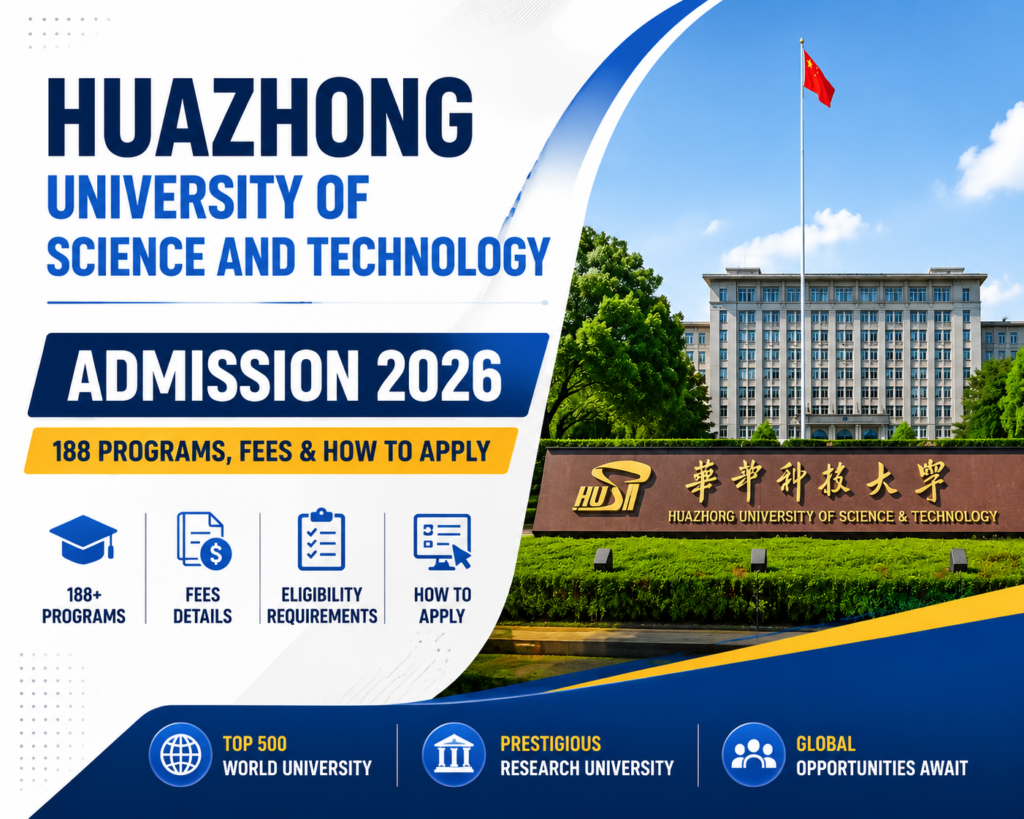
One hundred and eighty-eight. That’s how many programs Huazhong University of Science and Technology has thrown open to international students this intake. Four non-degree tracks, eight bachelor’s degrees, 77 master’s options, and a staggering 99 doctoral programs.
Most students never look past the MBBS. Fair enough, that’s the headline. But if you stop there, you miss the bigger story: HUST is one of the few Chinese universities where a Pakistani student can start with a Chinese language course and finish with a PhD in optics, all on the same campus in Wuhan.
Let me walk you through it.
Table of Contents
| # | Section |
| 1 | Why HUST Is Worth Your Attention |
| 2 | Non-Degree Programs (4 Options) |
| 3 | Bachelor’s Programs (8 Options) |
| 4 | Master’s Programs (77 Options) |
| 5 | Doctoral / PhD Programs (99 Options) |
| 6 | Admission Requirements |
| 7 | Tuition, Living Costs & Scholarships |
| 8 | How to Apply (Step by Step) |
| 9 | Why Apply Through Cosmopole |
| 10 | Frequently Asked Questions |
Why HUST Is Worth Your Attention
Sit down with any consultant who actually knows China, and Huazhong University of Science and Technology comes up fast. It’s in Wuhan, the big central-China city, and it sits inside both Project 985 and Project 211. For anyone who doesn’t speak the lingo yet: those are China’s two tiers of elite university funding. Being in both means you’re looking at a school the Chinese government has poured serious money into for decades.
The university came together in 2000 when three institutions merged. One of them was Tongji Medical College, which is where the medical reputation comes from. Tongji isn’t some afterthought medical wing bolted onto an engineering school. It’s one of the oldest and most respected medical colleges in the country, and it’s a big reason HUST’s MBBS pulls so many international applicants.
Then there’s the campus itself. People call it a “forest university” because so much of it is green. That sounds like a small thing until you’ve spent a winter on a grey concrete campus somewhere. HUST’s grounds are huge, leafy, and built for actually living there for five or six years.
On the ranking side, HUST regularly lands inside the global top 200 and sits comfortably in China’s top ten. You can check the current numbers on the official HUST English site before you apply, since rankings move around year to year.
Here’s my honest take. If your plan is medicine, the Tongji name carries weight back home and across the region. If your plan is engineering or science, HUST’s research output is the real draw, not the brochure photos. Either way, this is a serious university, not a degree mill.
Non-Degree Programs (4 Options)
Start here if your Chinese isn’t ready yet, or if you need a bridge before a full degree.
- Chinese Language (September start)
- Chinese Language (separate September intake)
- Premedical (March start)
- Premedical (September start)
The Chinese language track is straightforward. You spend a year or so getting your Mandarin to a usable level, usually aiming for HSK 4 or higher, which a lot of Chinese-taught degrees ask for.
The premedical program is the smarter pick for a specific kind of student. Say your FSc marks are decent but not quite at the cutoff for a direct MBBS seat, or you finished schooling a while back and want to refresh the sciences before jumping into a heavy medical degree. Premedical gives you that runway. Two intakes a year, March and September, so you’re not stuck waiting twelve months if you miss one.
One thing people get wrong: a non-degree program doesn’t automatically promote you into a degree. You still apply for the bachelor’s separately. Treat it as preparation, not a guaranteed back door.
Bachelor’s Programs (8 Options)
This is where most of the traffic goes, and it’s easy to see why.
- Pharmacy (September)
- Clinical Medicine (MBBS) (September)
- Nursing (September)
- Mechanical Design, Manufacture and Automation (March)
- Mechanical Design, Manufacture and Automation (September)
Plus three more rounding out the eight on offer.
Let’s talk about the one you came for. Clinical Medicine, the MBBS, taught in English at Tongji Medical College. It runs the standard length for China, roughly six years including the internship year, and it’s recognised by the major bodies a Pakistani graduate cares about, including the PMDC pathway and the WHO directory of medical schools. If China is on your shortlist for medicine, this program belongs near the top.
We’ve put together a full breakdown of how the China route works, fees, eligibility, the licensing exams afterward, on our MBBS in China page. Read that alongside this one. It answers the questions that come right after “which university.”
The Mechanical Design, Manufacture and Automation degree deserves more love than it gets. HUST is genuinely strong in engineering, and this program has two intakes, which is rare and useful. Pharmacy and Nursing fill out the health-science side for students who want to work in the medical field without doing the full MBBS grind.
A bit of straight talk. The bachelor’s degrees taught in English are limited, and the most in-demand seats, MBBS especially, fill early. If you’re aiming for September, don’t treat July as your deadline. Treat spring as your deadline.
Master’s Programs (77 Options)
Seventy-seven. This is where HUST quietly outshines a lot of its competitors, and almost nobody writes about it properly.
A sample of what’s open:
- Inorganic Chemistry (September)
- Analytical Chemistry (September)
- Organic Chemistry (September)
- Physical Chemistry (September)
- High Polymer Chemistry and Physics (September)
And another seventy-two beyond chemistry, spanning engineering, medicine, management, computer science, and the physical sciences.
The chemistry cluster alone tells you something. When a university offers five distinct chemistry master’s tracks, that’s a department with real depth, real labs, and real funding. You’re not joining a token program cobbled together for international fees.
Most master’s degrees at this level run two to three years. Some are taught in English, others in Chinese, and that distinction matters a lot for your application, so confirm the language of instruction for the exact program before you commit. A chemistry master’s taught in Chinese with an HSK requirement is a very different commitment from one delivered in English.
If postgraduate study in China is your actual goal, browse our master’s programs page for the wider picture across Chinese universities, not just HUST. Sometimes the right program is at a school you hadn’t considered.
Doctoral / PhD Programs (99 Options)
Ninety-nine PhD programs. That number genuinely surprised me the first time I saw it, and I’ve been doing this a while.
A taste of the research areas:
- Probability and Mathematical Statistics (September)
- Statistics (September)
- Condensed Matter Physics (September)
- Optics (September)
- Inorganic Chemistry (September)
Optics is worth flagging. HUST runs the Wuhan National Laboratory for Optoelectronics, which is one of the more important optics and photonics research centres in China. A PhD in optics here isn’t an empty line on a CV. It puts you inside a lab that does work people in the field actually read.
PhDs in China typically run three to four years, and here’s the part students don’t always realise: Chinese doctoral programs often come with funding. Between university waivers and the China Scholarship Council, a fully funded PhD is a real possibility, not a fantasy. You can read the official scholarship criteria straight from the China Scholarship Council before you apply.
A doctorate is a long, demanding commitment, and the application leans heavily on your research proposal and finding a supervisor who wants you. If that’s the road you’re on, our PhD programs page lays out how to approach it without wasting a year on guesswork.
Admission Requirements
Requirements shift by program level, so here’s the honest version rather than a one-size-fits-all checklist.
For the bachelor’s degrees, you’ll generally need your FSc or equivalent with strong marks, especially in the relevant subjects. MBBS asks for solid science grades, biology, chemistry, and physics, because the curriculum moves fast and assumes a foundation. You’ll also need a valid passport, your academic transcripts, a physical examination record, and a non-criminal certificate. For English-taught programs, students from non-English backgrounds may need to show English proficiency, though the exact bar depends on the program.
For master’s and PhD applications, the bar rises. You’ll need your previous degree and transcripts, two recommendation letters, a study or research plan, and for many programs, proof of language ability, whether that’s English or HSK for Chinese-taught tracks. PhD applicants almost always need to line up a supervisor, so start that conversation early.
Across the board, age limits apply at each level, documents usually need to be notarised, and some require attestation. This is the stage where small mistakes cost you a whole intake. A missing notarisation or a transcript in the wrong format can push your start date back six months.
If you want someone to check your file before you submit, that’s exactly what we’re here for. Get in touch and we’ll go through your documents with you.
Tuition, Living Costs & Scholarships
Let me set expectations honestly: I’m giving you ballpark ranges, because HUST adjusts fees each year and they vary by program.
Tuition for English-taught bachelor’s programs, MBBS included, generally falls in the range you’d expect from a top-tier Chinese university, higher than a mid-ranked school but still far below what the same degree costs in the West. Engineering and science bachelor’s degrees usually sit lower than medicine. Master’s and PhD tuition varies widely, and many research programs are partially or fully covered by scholarships.
Living in Wuhan is the good news. It’s a major city with major-city amenities, but the cost of living is reasonable. On-campus accommodation, food, and day-to-day expenses are manageable on a student budget, and many students keep monthly costs modest if they cook and live on campus.
On scholarships, there are three main routes worth knowing. The Chinese Government Scholarship through the CSC is the big one and can cover tuition, accommodation, and a monthly stipend. There are provincial and university scholarships too, which are often easier to land than the headline national award. And for research students, supervisor-linked funding is common.
Don’t assume scholarships are only for geniuses. Plenty are awarded on a complete, well-prepared application that simply arrives on time. The students who miss out are usually the ones who applied late or left a document blank.
How to Apply (Step by Step)
Here’s the path, start to finish.
First, pick your program and confirm the language of instruction and the start date. March and September are the two main intakes, and missing one means a long wait.
Second, get your documents in order. Passport, transcripts, certificates, recommendation letters, study plan, medical and police records. Notarise and attest what needs it. Build in time, this step always takes longer than people think.
Third, submit your application through the university’s international admissions portal, pay the application fee, and apply for any scholarship in parallel, because scholarship deadlines often close before regular admission deadlines.
Fourth, wait for the admission notice and the JW202 form, which you’ll need for your student visa.
Fifth, apply for your X visa at the Chinese embassy, book your travel, and sort accommodation.
It’s not complicated, but it’s unforgiving on timing. One late document and you’re applying for the next intake.
Why Apply Through Cosmopole
I’ll keep this honest because you can smell a hard sell a mile off.
You can absolutely apply to HUST on your own. People do it every year. But the students who run into trouble usually trip on the same things: choosing the wrong program for their background, missing a notarisation, applying too late for the seat they wanted, or fumbling the scholarship paperwork.
That’s the gap we fill. We’ve sent students to Chinese universities across the board, from non-degree tracks to PhDs, and we know which HUST programs fill fast, which documents trip people up, and how to time an application so you’re not left waiting a year. We also handle the routes beyond HUST, including diploma programs if a full degree isn’t the right fit yet.
No pressure either way. If you just want a second pair of eyes on your file, reach out and we’ll point you straight.
Frequently Asked Questions
Is Huazhong University of Science and Technology recognised in Pakistan?
Yes. HUST is a Project 985 and 211 university, and its medical degree appears in the WHO directory, which matters for the PMDC licensing pathway. Always confirm the current recognition status for your specific degree before you enrol.
How long is the MBBS at HUST?
The Clinical Medicine (MBBS) program runs roughly six years, including the internship year. It’s taught in English at Tongji Medical College.
Do I need to know Chinese to study at HUST?
For English-taught programs, no, though some basic Chinese helps with daily life. For Chinese-taught programs, you’ll usually need an HSK score, often HSK 4 or higher. Check the language of instruction for each program, since it varies even within the same subject.
Can I get a scholarship at HUST?
Yes. Options include the Chinese Government Scholarship through the CSC, provincial and university scholarships, and supervisor-linked funding for research students. PhD applicants in particular have strong funding chances.
What’s the difference between the non-degree and degree programs?
Non-degree tracks like Chinese language and premedical prepare you for a full degree but don’t automatically admit you into one. You apply for the bachelor’s, master’s, or PhD separately.
When should I start my application?
Sooner than you think. For a September intake, treat spring as your real deadline, especially for popular seats like MBBS. Scholarship deadlines often close even earlier than admission deadlines.
The Bottom Line
Most students walk into the China decision thinking about one degree at one university. HUST is the rare case where the question isn’t “will they take me,” it’s “which of these 188 doors do I want to walk through.” Medicine, engineering, chemistry, optics, a master’s, a fully funded PhD. It’s all on one campus in Wuhan.
The seats fill in the order people apply, not the order they deserve them. So if HUST is on your list, the smartest thing you can do today isn’t more research. It’s getting your documents moving.





Leave A Comment