

Most people have never heard of Ningbo. That’s the first thing worth saying.
Ask a Pakistani student where they want to study in China, and you’ll hear Beijing, Shanghai, maybe Wuhan. Almost nobody says Ningbo. Which is funny, because Ningbo is one of the oldest port cities in China, sits an hour from Shanghai by high-speed rail, and is home to a university that’s quietly become one of the better-value options for international students.
Ningbo University isn’t trying to be the flashiest name on your list. It’s trying to be the smart one.
Let me show you what’s actually on offer for the 2026 intake, and who it’s right for.
Table of Contents
| # | Section |
| 1 | Why Ningbo University Deserves a Second Look |
| 2 | Non-Degree Programs |
| 3 | Bachelor’s Programs (14 Options) |
| 4 | Master’s Programs |
| 5 | Doctoral / PhD Programs |
| 6 | Admission Requirements |
| 7 | Tuition, Living Costs & Scholarships |
| 8 | How to Apply (Step by Step) |
| 9 | Why Apply Through Cosmopole |
| 10 | Frequently Asked Questions |
Why Ningbo University Deserves a Second Look
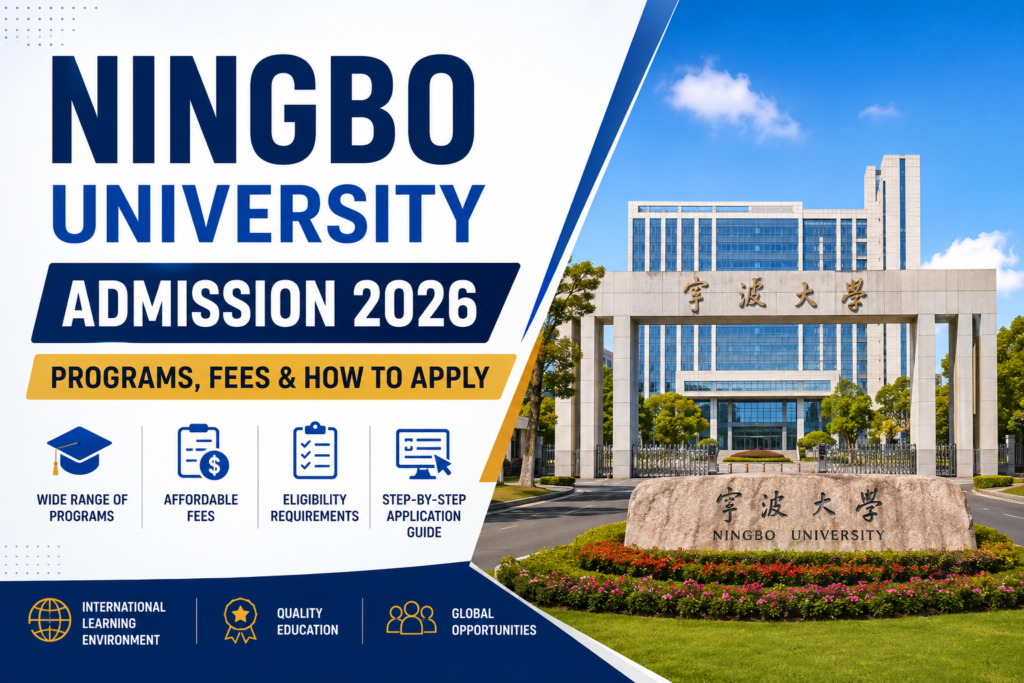
Here’s the short version. Ningbo University was founded in 1986 with money from a Hong Kong shipping magnate, Sir Yue-Kong Pao. That origin tells you something about the place. It was built around trade, the sea, and business, and those strengths still run right through the university today.
It’s a Double First Class university, which is China’s current top-tier designation, the system that replaced the old Project 211 and 985 labels. Getting on that list isn’t automatic. It means the Chinese government has flagged Ningbo as a school worth investing in nationally, not just regionally.
Now the location, because this matters more than students realise. Ningbo sits in Zhejiang province, on the east coast, in one of the wealthiest and most developed parts of China. It’s a major port, one of the busiest in the world by cargo volume. Shanghai is right next door. So you’re not stuck in some remote inland city. You’re in the economic heart of coastal China, with a lower cost of living than Shanghai itself.
The university’s real strength shows in its program list. Marine science, aquaculture, fishery resources, port and shipping management. These aren’t programs you find everywhere, and Ningbo does them genuinely well because the whole city is built around the sea. If your interests run toward marine science, logistics, or trade, there are few better-placed universities in the country.
My honest read? Ningbo is an underrated pick. It won’t have the brand recognition of a Tsinghua back home. But for the right student, in the right field, at the right price, it punches well above its reputation. You can check its current standing on the official Ningbo University English site before you decide.
Non-Degree Programs
There’s one non-degree track on offer, and it’s the Chinese Language program.
- Chinese Language (March / September start)
This one’s flexible, with two intakes a year, so you’re not waiting twelve months if you miss the spring window. It’s the right starting point for two kinds of students. First, anyone planning a Chinese-taught degree later, where you’ll usually need an HSK score before they let you in. Second, students who want a year in China to settle in, get the language down, and figure out their next move without committing to a full four-year degree on day one.
A quick reality check. The language program is preparation, not a guaranteed seat in a degree. You still apply for the bachelor’s or master’s separately. Treat it as a runway, not a back door.
Bachelor’s Programs (14 Options)
This is the deepest part of Ningbo’s offering, and the variety is genuinely good. Here’s what’s open for September 2026:
| Program | Duration | Language |
| MBBS | 6 years | English |
| Computer Science | 4 years | English |
| Finance | 4 years | English |
| Fine Arts | 4 years | English |
| International Economy and Trade | 4 years | English |
| Logistics Management | 4 years | English |
| Mechanical Engineering & Automation | 4 years | English |
| Product Design | 4 years | English |
| Architecture | 4 years | English |
| Visual Communication Design | 4 years | English |
| Business Administration | 4 years | Chinese |
| Tourism Management | 4 years | Chinese/French |
Let’s talk about the headliner first. The MBBS runs six years, taught in English, which is the standard structure for medicine in China. If medicine is your goal, this is the program drawing the most attention, and the seats go fast. We’ve written a full breakdown of how the China medical route works, fees, eligibility, the licensing exams you face afterward, on our MBBS in China page. Read that next to this one, because it answers the questions that come right after “which university.”
But here’s where Ningbo gets interesting, and where I’d push you to look beyond just the MBBS. Logistics Management and International Economy and Trade, both taught in English, sit right in the university’s wheelhouse. You’re studying trade and shipping in one of the world’s biggest port cities. That’s not a coincidence you should ignore. The practical exposure you get in a place like Ningbo is hard to match at an inland university.
Computer Science and Finance, also in English, are the safe, high-demand picks that travel well. Product Design, Fine Arts, Visual Communication Design, and Architecture round out a surprisingly strong creative cluster, which you don’t always see at a science-leaning Chinese university.
One thing to flag clearly. Business Administration is taught in Chinese, and Tourism Management is taught in Chinese or French. So if your Mandarin or French isn’t there yet, those two are off the table until it is. Always confirm the language of instruction before you set your heart on a program. It’s the single most common mistake I see students make.
Master’s Programs
The master’s list is smaller but well-targeted, and it leans hard into Ningbo’s strengths. Everything here starts in September.
| Program | Duration | Language |
| Aquaculture | 3 years | English |
| Fishery Resources | 3 years | English |
| Business Administration | 2.5 years | English |
| Sino-Australian MBA | 2 years | English |
| Communication and Information System | 3 years | English |
| Materials Engineering | 3 years | English |
| Port and Shipping Technology and Management Engineering | 3 years | English |
| Tourism Management | 3 years | Chinese/French |
A few of these stand out. The Sino-Australian MBA is the one I’d flag first. It’s a joint program, which usually means an international curriculum and sometimes a dual-credential pathway, and at two years it’s the quickest route to a master’s on this list. For working professionals or anyone who wants a business degree with an international flavour, that’s worth a close look.
Then there’s Aquaculture, Fishery Resources, and Port and Shipping Technology and Management. This is Ningbo doing what Ningbo does best. If you’re in marine science, fisheries, or maritime logistics, this is one of the strongest places in China to do a master’s, full stop. The faculty, the location, the industry links, they all line up.
Materials Engineering and Communication and Information System cover the engineering side for students who want a research-heavy technical master’s in English.
If postgraduate study in China is your real goal, browse our master’s programs page for the wider view across Chinese universities. Sometimes the best fit is at a school you hadn’t put on your list yet.
Doctoral / PhD Programs
The PhD offering at Ningbo is focused and specialised, which is exactly what you’d expect from a university with a clear identity. Both programs start in September and are taught in English.
| Program | Duration | Language |
| Aquaculture | 3 years | English |
| Fishery Resources | 3 years | English |
No surprises here, and that’s a good thing. These two PhDs sit at the centre of Ningbo’s research reputation. Marine science and fisheries are where the university has built real depth, real labs, and real funding over decades.
If your research interests run toward aquaculture or fishery resources, this is a serious destination, not a fallback. A PhD here puts you inside a program that does work people in the field actually read.
A couple of practical points on Chinese PhDs in general. They typically run three to four years, and they often come with funding, sometimes full funding through university waivers and the China Scholarship Council. You can read the official scholarship criteria straight from the China Scholarship Council before you apply. The application also leans heavily on your research proposal and on lining up a supervisor who wants to work with you, so start that conversation early. Our PhD programs page walks through how to approach it without burning a year on guesswork.
Admission Requirements
Requirements shift by program level, so here’s the honest version rather than a generic checklist.
For the bachelor’s degrees, you’ll generally need your FSc or equivalent with solid marks, especially in subjects relevant to your program. MBBS expects strong science grades, biology, chemistry, and physics, because the curriculum moves fast and assumes a foundation. You’ll also need a valid passport, your academic transcripts, a physical examination record, and a non-criminal certificate. For English-taught programs, students from non-English backgrounds may need to show English proficiency, and the exact bar depends on the program.
For master’s and PhD applications, the bar rises. You’ll need your previous degree and transcripts, usually two recommendation letters, a study or research plan, and proof of language ability, English for the English-taught tracks or HSK for the Chinese-taught ones. PhD applicants almost always need to secure a supervisor in advance.
Across every level, age limits apply, documents typically need to be notarised, and some need attestation too. This stage is where small mistakes cost you a whole intake. A missing notarisation or a transcript in the wrong format can push your start date back a full year. If you want someone to check your file before you submit, that’s exactly what we do. Get in touch and we’ll go through your documents with you.
Tuition, Living Costs & Scholarships
Let me set expectations honestly. These are ballpark ranges, because Ningbo adjusts fees each year and they vary by program.
Tuition at Ningbo is one of its strongest selling points. As a coastal Double First Class university, it offers a quality education at a price that sits below the big-name Shanghai and Beijing schools. English-taught bachelor’s programs, including MBBS, fall in the range you’d expect from a solid mid-to-upper Chinese university, well below what the same degree costs in the West. Engineering, business, and science bachelor’s degrees usually run lower than medicine. Master’s and PhD tuition varies, and many research programs are partially or fully covered by scholarships.
Living in Ningbo is where the value really shows. It’s a wealthy, developed coastal city with all the amenities of a modern Chinese metropolis, but the cost of living is noticeably lower than nearby Shanghai. On-campus accommodation, food, and daily expenses stay manageable on a student budget, especially if you live on campus and cook.
On scholarships, three routes are worth knowing. The Chinese Government Scholarship through the CSC is the big one and can cover tuition, accommodation, and a monthly stipend. Provincial and university scholarships exist too, and they’re often easier to land than the headline national award, especially in a wealthy province like Zhejiang that funds its universities well. And for research students, supervisor-linked funding is common.
Don’t assume scholarships are only for top students. Plenty go to applicants with a complete, well-prepared file that simply arrives on time. The ones who miss out are usually the ones who applied late or left a section blank.
How to Apply (Step by Step)
Here’s the path, start to finish.
First, pick your program and confirm the language of instruction and the start date. Most degrees here start in September, with the Chinese language track also offering a March intake. Missing your window means a long wait, so plan around it.
Second, get your documents in order. Passport, transcripts, certificates, recommendation letters, study plan, medical and police records. Notarise and attest whatever needs it. Build in time, because this step always takes longer than people expect.
Third, submit your application through the university’s international admissions portal, pay the application fee, and apply for any scholarship in parallel. Scholarship deadlines usually close before regular admission deadlines, so don’t leave them till the end.
Fourth, wait for your admission notice and the JW202 form, which you’ll need for the student visa.
Fifth, apply for your X visa at the Chinese embassy, book your travel, and sort out accommodation.
It’s not complicated. But it’s unforgiving on timing. One late document and you’re applying for the next intake.
Why Apply Through Cosmopole
I’ll keep this honest, because you can smell a hard sell from a mile off.
You can apply to Ningbo on your own. People do it every year. But the students who hit trouble usually trip on the same things, choosing the wrong program for their background, missing a notarisation, applying too late for the seat they wanted, or fumbling the scholarship paperwork.
That’s the gap we fill. We’ve placed students across Chinese universities, from language courses to PhDs, and we know which programs fill fast, which documents trip people up, and how to time an application so you’re not left waiting a year. We also handle the routes beyond a full degree, including diploma programs if that’s a better fit for where you are right now.
No pressure either way. If you just want a second pair of eyes on your file, reach out and we’ll point you straight.
Frequently Asked Questions
Is Ningbo University recognised in Pakistan?
Yes. Ningbo University is a Double First Class university, China’s current top-tier designation, and its medical program appears in the WHO directory, which matters for the PMDC licensing pathway. Always confirm the current recognition status for your specific degree before you enrol.
How long is the MBBS at Ningbo University?
The MBBS runs six years and is taught in English, which is the standard structure for medical degrees in China.
Do I need to know Chinese to study at Ningbo?
For most programs, no, since the majority of degrees here are taught in English. But Business Administration is taught in Chinese, and Tourism Management is in Chinese or French, so those need the relevant language. Always check the language of instruction for your specific program.
What is Ningbo University best known for?
Marine science, aquaculture, fishery resources, and port and shipping management. The university sits in one of the world’s busiest port cities, so its maritime and trade-related programs are genuinely strong.
Can I get a scholarship at Ningbo University?
Yes. Options include the Chinese Government Scholarship through the CSC, provincial and university scholarships, and supervisor-linked funding for research students. A complete application submitted on time gives you a real shot.
When should I start my 2026 application?
Sooner than you think. For a September 2026 intake, treat early in the year as your real deadline, especially for popular seats like MBBS. Scholarship deadlines often close earlier than admission deadlines.
The Bottom Line
Everyone chases the famous names. Beijing, Shanghai, the universities everyone’s heard of. And there’s nothing wrong with that.
But the smart play isn’t always the obvious one. Ningbo gives you a top-tier Double First Class university, in a wealthy coastal city next to Shanghai, with strong English-taught programs in medicine, business, engineering, and marine science, at a price that won’t wreck your family’s finances. For the right student, that combination is hard to beat.
The seats fill in the order people apply, not the order they deserve them. So if Ningbo’s on your list for 2026, the smartest move today isn’t more research. It’s getting your documents moving.





Leave A Comment