


If you want to learn Chinese, properly, in the city where the language lives, there’s a short list of universities people who know actually recommend. Capital Normal University is on it.
Most students chasing a Beijing education fixate on the two or three names everyone’s heard of. Fair enough. But ask the international students who’ve spent a year in the capital getting their Mandarin from zero to fluent, and a lot of them will point you here. CNU built its reputation on teaching, and that includes teaching foreigners the language better than most.
But it’s not just a language school. There’s a full degree ladder here, bachelor’s through PhD, across arts, sciences, and education. Let me walk you through what’s open for 2026 and who it’s right for.
Table of Contents
| # | Section |
| 1 | Why Capital Normal University Stands Out |
| 2 | Non-Degree & Chinese Language Programs |
| 3 | Bachelor’s Programs |
| 4 | Master’s Programs |
| 5 | Doctoral / PhD Programs |
| 6 | Admission Requirements |
| 7 | Tuition, Living Costs & Scholarships |
| 8 | How to Apply (Step by Step) |
| 9 | Life in Beijing as an International Student |
| 10 | Why Apply Through Cosmopole |
| 11 | Frequently Asked Questions |
Why Capital Normal University Stands Out
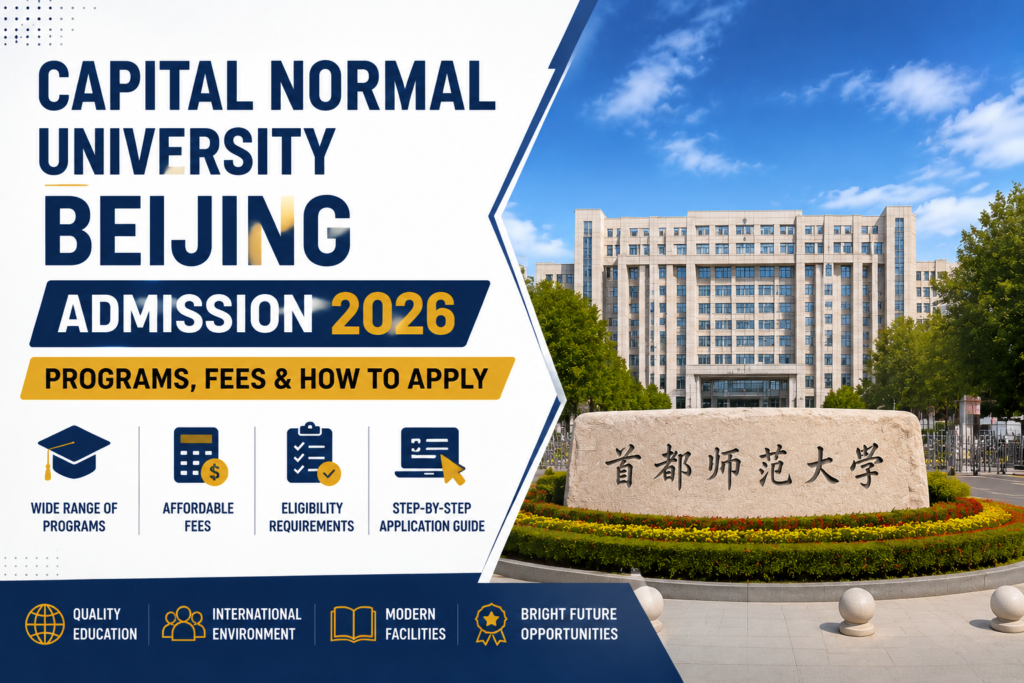
Here’s the short version. Capital Normal University, founded in 1954, is one of Beijing’s key public universities. The word “Normal” in the name throws a lot of people. It doesn’t mean ordinary. It comes from the French école normale, and across the world it signals a university that trains teachers. So at its core, CNU is a teaching university, and that DNA runs through everything it does.
Why does that matter to you? Because a university built on the science of teaching tends to be very, very good at the one thing most international students come to China for first: learning the language. CNU’s Chinese language programs have a strong reputation precisely because teaching is what the institution does best.
It’s also a “Double First Class” discipline university, China’s current tier of national academic recognition, which replaced the old 211 and 985 labels. Several of its subjects carry serious national standing, especially in education, liberal arts, mathematics, and the sciences.
Then there’s the location, and this is the real draw. CNU sits in Haidian District, the academic heart of Beijing. You’re in the capital. You’re surrounded by China’s top universities, its biggest libraries, its cultural institutions, its government, its history. For learning the language and the culture at the same time, there are few better places to plant yourself for a year or four. You can check the university’s current standing on the official Capital Normal University English site before you decide.
My honest read? If your goal is Mandarin, Chinese culture, education, or the liberal arts and sciences, and you want to do it in Beijing without the brutal cutoff of the very top schools, CNU is one of the smartest picks in the city. It’s a serious university with a teaching soul, and that combination is rarer than it sounds.
Non-Degree & Chinese Language Programs
This is CNU’s calling card, and where I’d start most students.
The Chinese Language program is the flagship. It typically runs with multiple intakes through the year, commonly spring and autumn, and you can join for a single semester, a full year, or longer depending on how far you want to take your Mandarin. Levels run from absolute beginner right up to advanced, and the teaching is built to move you through the HSK proficiency levels, which is the standard benchmark Chinese-taught degrees ask for later.
There are usually a few non-degree options sitting alongside the core language track. Short-term cultural and language programs for students who want a taste rather than a full commitment, and senior-scholar or visiting-student arrangements for people already in academia who want time in Beijing.
Who’s this for? Three kinds of students. Those who want to become fluent in Mandarin as a goal in itself, which opens real career doors worldwide. Those planning a Chinese-taught degree later, who need an HSK score before a university will let them in. And those who want a year in Beijing to live the culture, build the language, and decide their next move without locking into a four-year degree on day one.
One honest note. A non-degree language program prepares you for a degree, but it doesn’t automatically promote you into one. You apply for the bachelor’s or master’s separately. Treat the language year as a runway, not a guaranteed back door.
Bachelor’s Programs
Quick, important caveat before the list: the exact slate of English-taught and Chinese-taught bachelor’s degrees open to international students shifts every cycle, so confirm the live 2026 list and the language of instruction for your specific program before you set your heart on it. What follows reflects the areas CNU is known for.
CNU’s bachelor’s strengths sit in education, the liberal arts, languages, mathematics, and the sciences. For international students, the most common degree-level routes are Chinese Language and Literature, which is the natural progression for students who’ve completed the language program and want a full degree in the field, and education-related programs that play to the university’s core identity.
Many full bachelor’s degrees at a teaching-focused university like CNU are taught in Chinese, which is exactly why the language program matters so much. If your Mandarin is strong and you want to study the language, its literature, or education at a deep level in the capital, this is a genuinely strong place to do it. Where English-taught undergraduate options exist, they tend to be limited and competitive, so confirm availability early.
Most bachelor’s degrees run four years, the standard length in China.
Master’s Programs
The postgraduate level is where CNU’s academic depth really shows, across education, the humanities, mathematics, the sciences, and more.
For international students, the master’s options generally cluster around the university’s flagship disciplines. Teaching Chinese to Speakers of Other Languages, often called MTCSOL, is a standout. If you’ve fallen in love with Mandarin and want to turn it into a career teaching the language worldwide, this is one of the most relevant master’s degrees you can do, and CNU’s teaching pedigree makes it a natural home for it. Education and applied linguistics master’s programs build on the same strength.
Beyond language and education, CNU offers postgraduate research across mathematics, the physical and life sciences, and the humanities. Some programs are taught in English, others in Chinese, and that distinction is critical for your application, so confirm the language of instruction for the exact program before you commit. Most master’s degrees run two to three years.
If postgraduate study in China is your real goal, browse our master’s programs page for the wider view across Chinese universities, not just CNU. Sometimes the best fit for your subject is at a school you hadn’t put on your list yet.
Doctoral / PhD Programs
CNU offers doctoral study across its core research strengths, and the picture here mirrors the master’s level: education, linguistics and the teaching of Chinese, mathematics, the sciences, and the humanities.
A PhD at a research-active university in the capital carries real weight, especially in the fields CNU is genuinely strong in. If your research sits in Chinese language pedagogy, applied linguistics, education, or one of the university’s strong science or maths areas, this is a serious destination rather than a fallback.
A few practical points on Chinese PhDs in general. They typically run three to four years, and they often come with funding, sometimes full funding, through a mix of university waivers and the China Scholarship Council. You can read the official scholarship criteria straight from the China Scholarship Council before you apply. The application leans heavily on your research proposal and on lining up a supervisor who actually wants to work with you, so start that conversation early. Our PhD programs page lays out how to approach it without burning a year on guesswork.
Admission Requirements
Requirements shift by program level, so here’s the honest version rather than a generic checklist.
For the Chinese language and non-degree programs, the bar is low and welcoming. You generally need to be a healthy adult, hold a valid passport, and have finished high school. No prior Chinese is required for the beginner track, which is the whole point. This is the most accessible way into the university for students worldwide.
For bachelor’s degrees, you’ll generally need your high school diploma or equivalent with solid grades, and for Chinese-taught programs, an HSK score, often HSK 4 or higher depending on the program. You’ll also need a valid passport, academic transcripts, a physical examination record, and a non-criminal certificate. For any English-taught options, students from non-English backgrounds may need to show English proficiency.
For master’s and PhD applications, the bar rises. You’ll need your previous degree and transcripts, usually two recommendation letters, a study or research plan, and proof of language ability, English for English-taught tracks or HSK for Chinese-taught ones. PhD applicants almost always need to secure a supervisor in advance.
Across every level, age limits apply, documents typically need to be notarised, and many need attestation, often legalised through the Chinese embassy in your home country. This stage is where small mistakes cost you a whole intake. If you want someone to check your file before you submit, that’s exactly what we do. Get in touch and we’ll go through your documents with you.
Tuition, Living Costs & Scholarships
Let me set expectations honestly. These are ballpark ranges, because CNU adjusts fees each year and they vary by program.
Tuition for the Chinese language program is typically charged per semester or per year, and it sits in the reasonable range you’d expect for a public Beijing university. Degree programs cost more, with bachelor’s, master’s, and PhD tuition rising with the level, though many research programs are partially or fully covered by scholarships.
Now, the honest part about Beijing. It’s the capital, and it’s not the cheapest city in China. Living costs run higher here than in smaller inland cities, so factor that into your budget realistically. That said, on-campus or university-arranged accommodation keeps a lid on your biggest expense, and student life in Beijing can still be done affordably if you live on campus, eat at the canteens, and use the excellent public transport rather than taxis.
On scholarships, three routes are worth knowing, and they apply to students worldwide. The Chinese Government Scholarship through the CSC is the big one and can cover tuition, accommodation, and a monthly stipend. The Beijing Government Scholarship is a regional award specific to the capital, which is often a strong option for students at Beijing universities. And there are university-level scholarships and, for research students, supervisor-linked funding.
Don’t assume scholarships are only for geniuses. Plenty go to applicants with a complete, well-prepared file that simply arrives on time. The ones who miss out are usually the ones who applied late or left a section blank.
How to Apply (Step by Step)
Here’s the path, start to finish, wherever in the world you’re applying from.
First, pick your program and confirm the language of instruction, the intake date, and the deadline. The language program often has spring and autumn intakes, while most degrees start in September. Missing your window means a long wait, so plan around it.
Second, get your documents in order. Passport, transcripts, certificates, recommendation letters, study plan, medical and police records. Notarise and attest whatever needs it, and legalise documents through the Chinese embassy in your country where required. Build in time, because this step always takes longer than people expect, and the requirements vary by country.
Third, submit your application through the university’s international admissions portal, pay the application fee, and apply for any scholarship in parallel. Scholarship deadlines usually close before regular admission deadlines, so don’t leave them till last.
Fourth, wait for your admission notice and the JW202 form, which you’ll need for the student visa.
Fifth, apply for your X visa at the Chinese embassy or consulate in your country, book your travel, and sort out accommodation.
It’s not complicated. But it’s unforgiving on timing. One late or wrongly-legalised document and you’re applying for the next intake.
Life in Beijing as an International Student
You’re not just picking a university. You’re picking a city to live in, so this matters.
Beijing is one of the great world capitals, full stop. You’ve got the Forbidden City, the Great Wall an hour out, the Summer Palace, world-class museums, and a food scene that runs from street-side dumplings to anything you could want. As a hub, it connects to the rest of China and the world easily, which makes weekend travel and trips home straightforward.
For international students specifically, Beijing has one of the largest and most diverse foreign-student communities in China. You won’t be the only person figuring out a new country. There are students from every continent here, established communities, and the kind of infrastructure, international clinics, varied food, English-speaking services in places, that makes landing in a new country far less daunting.
CNU’s location in Haidian puts you in the academic district, surrounded by other universities and the energy that comes with that. The trade-offs are honest: Beijing is big, it can be expensive, winters are cold, and the pace is fast. But for immersing yourself in the language and culture while living in a true global capital, few places compete.
Why Apply Through Cosmopole
I’ll keep this honest, because you can smell a hard sell from a mile off.
You can apply to CNU on your own. Students worldwide do it every year. But the ones who hit trouble usually trip on the same things: choosing the wrong program or the wrong language of instruction for their level, missing a notarisation or a country-specific legalisation step, applying too late for the seat they wanted, or fumbling the scholarship paperwork.
That’s the gap we fill. We’ve placed students into Chinese universities across the board, from language courses to PhDs, and we know which programs fill fast, which documents trip people up, and how to time an application so you’re not left waiting a year. We also handle the routes beyond a full degree, including diploma programs if that’s a better fit for where you are right now.
No pressure either way. If you just want a second pair of eyes on your file, reach out and we’ll point you straight.
Frequently Asked Questions
What is Capital Normal University best known for?
Teaching and the Chinese language. As a “Normal” (teacher-training) university, CNU has a strong reputation for its Chinese language programs and for education, the liberal arts, mathematics, and the sciences. It’s a popular choice for international students learning Mandarin in Beijing.
Do I need to know Chinese to study at CNU?
For the Chinese language program, no, beginners are welcome from zero. For Chinese-taught degrees, you’ll usually need an HSK score, often HSK 4 or higher. Where English-taught degrees exist, the language requirement differs, so always check the language of instruction for your specific program.
Does CNU offer programs in English?
Some, but as a teaching-focused university, many full degrees are taught in Chinese, which is why the language program is so central. English-taught options exist but can be limited and competitive, so confirm the live 2026 list before you apply.
Can international students get a scholarship at CNU?
Yes. Options open to students worldwide include the Chinese Government Scholarship through the CSC, the Beijing Government Scholarship, university-level awards, and supervisor-linked funding for research students. A complete application submitted on time gives you a real shot.
When can I start at Capital Normal University?
The Chinese language program often has spring and autumn intakes, giving you flexibility. Most full degrees start in September. Always confirm the exact 2026 dates and deadlines for your chosen program, since scholarship deadlines usually close earlier.
Is Beijing expensive for international students?
It’s pricier than smaller Chinese cities, since it’s the capital. But living on campus, eating at university canteens, and using public transport keeps costs manageable, and scholarships can cover a large part of your expenses if you land one.
The Bottom Line
Everyone chases the two or three Beijing names they already know. There’s nothing wrong with that.
But if your goal is to actually learn the language, to live the culture, and to study at a university that has spent seventy years getting good at teaching, Capital Normal University is the quiet, smart pick. A teaching soul, a Beijing address, a full ladder from your first Chinese character to a PhD, and real scholarship routes open to students worldwide.
The seats fill in the order people apply, not the order they deserve them. So if CNU is on your list for 2026, the smartest move today isn’t more research. It’s getting your documents moving.






Leave A Comment