


Let me guess. You typed “MBBS in HBUAS” into Google, scrolled through five sites that all said the same vague thing, and none of them actually told you what it costs or whether your marks are good enough.
I’ve seen those pages. They’re useless.
So here’s the deal. This is a straight, no-fluff guide to studying MBBS at Hubei University of Arts and Science for the 2026 intake. Real numbers where I can give them, honest caveats where I can’t, and a clear picture of who this university is actually right for. Grab a chai. Let’s go through it properly.
Table of Contents
| # | Section |
| 1 | What Is HBUAS, Really? |
| 2 | Why Pakistani Students Pick HBUAS for MBBS |
| 3 | MBBS at HBUAS: The Basics |
| 4 | Fee Structure for 2026 |
| 5 | Eligibility Requirements |
| 6 | Documents You’ll Need |
| 7 | How to Apply (Step by Step) |
| 8 | Recognition: Is the Degree Worth It Back Home? |
| 9 | Life at HBUAS in Xiangyang |
| 10 | Why Apply Through Cosmopole |
| 11 | Frequently Asked Questions |
What Is HBUAS, Really?
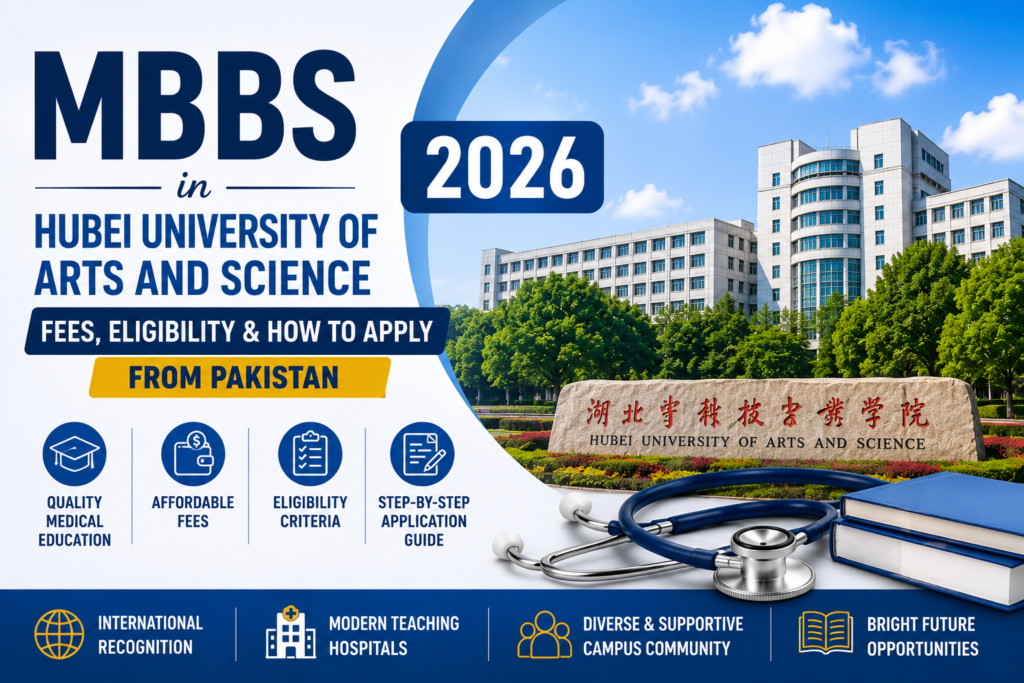
Hubei University of Arts and Science, HBUAS for short, sits in Xiangyang, a city in Hubei province in central China. The name throws people off. “Arts and Science” sounds like it’s all painting and poetry. It isn’t. It’s a full public university with a proper medical school, and the medical program is exactly why it’s on your radar.
The university is a government-run public institution, not a private college. That matters more than students realise, and I’ll come back to it when we talk recognition.
Xiangyang itself is a historic city, more than two thousand years old, with a famous ancient wall and a calmer pace than the megacities. It’s not Beijing. It’s not Shanghai. And for a lot of students, that’s a feature, not a bug. Smaller city, lower cost of living, fewer distractions, easier to focus on a degree that’s going to demand a lot of you.
You can check the university’s current details on the official HBUAS English site before you commit, since universities update their international pages every cycle.
Why Pakistani Students Pick HBUAS for MBBS
I’ll be honest with you, because the other sites won’t.
HBUAS isn’t a top-50 Chinese university. It’s not going to carry the brand weight of a Tsinghua or a Fudan when you say the name. So why do students choose it?
Three reasons, and they’re good ones.
First, the cost. HBUAS sits at the affordable end of the China MBBS market. For families who want their kid in a recognised, English-taught medical program without the bill that comes with a famous-name university, it’s one of the more sensible picks out there.
Second, it’s English-taught. The MBBS program runs in English, which removes the single biggest barrier for international students. You’re not spending your first year wrestling with Mandarin before you can even open a textbook.
Third, the admission bar is realistic. The top universities have cutoffs that knock out a lot of perfectly capable students. HBUAS gives students with solid-but-not-stellar FSc marks a genuine, recognised route into medicine. That’s a real thing, and there’s no shame in it.
My honest take? If your dream school is on your list, chase it. But if you want a recognised MBBS, taught in English, at a price your family can actually manage, HBUAS earns its place on the shortlist. It’s a practical choice, and there’s nothing wrong with a practical choice when the goal is becoming a doctor.
MBBS at HBUAS: The Basics
Here’s the shape of the program.
The MBBS at HBUAS runs for six years. That breaks down into roughly five years of academic study and coursework, followed by a one-year clinical internship. This is the standard structure for medical degrees across China, so HBUAS isn’t doing anything unusual here.
The medium of instruction is English for the core medical curriculum. You’ll still learn some basic Chinese along the way, and that’s not just a box-ticking exercise. During your clinical years, you’ll be in hospitals dealing with Chinese-speaking patients, so a working grasp of Mandarin genuinely helps. Take the language classes seriously when they come.
The intake is September. China’s main medical intake runs once a year, in the autumn, so there’s no spring backup for MBBS. Miss the 2026 September window and you’re looking at 2027. That single fact should shape your entire timeline.
We’ve put together a complete breakdown of how the China MBBS route works overall, the licensing exams you’ll face afterward, the eligibility details, the year-by-year structure, on our MBBS in China page. Read that alongside this guide. It answers the questions that come right after “which university.”
Fee Structure for 2026
Right, the part everyone scrolls down to first.
I’ll give you the honest version: I’m describing ranges and structure, not quoting exact rupee figures, because HBUAS adjusts its fees each year and the final numbers depend on accommodation choices, the exchange rate, and which scholarship, if any, you land. Anyone online quoting you an exact, fixed total for 2026 is guessing. Get the live figure confirmed before you commit a single rupee.
Here’s what makes up your total cost, so you understand exactly what you’re paying for.
Tuition is the main annual fee, and at HBUAS it sits in the affordable band for English-taught MBBS in China, noticeably below the famous-name universities. You pay it each year for the duration of the program.
Accommodation is charged separately, usually per year, and the amount depends on whether you take a shared or single room in the international dorms. On-campus housing is almost always cheaper than living off-campus, especially early on.
Then there are the one-time and recurring extras: the application fee, an insurance fee that’s mandatory for all international students in China, a residence permit fee, and a refundable or non-refundable service deposit depending on the setup.
And finally your living costs, food, transport, phone, daily life. Xiangyang is a smaller, lower-cost city, so this is where students save real money compared to studying in Shanghai or Beijing. Cook some of your own meals, live on campus, and your monthly outgoings stay very manageable.
One more thing on money. Some students at affordable universities like HBUAS may qualify for partial scholarships or tuition waivers, depending on the year and their academic record. It’s worth asking about, but don’t bank your whole plan on it. Build your budget around paying full fees, and treat any scholarship as a bonus.
Eligibility Requirements
Let’s see if you actually qualify before you get your hopes up.
For MBBS at HBUAS, you’ll generally need to have completed your FSc Pre-Medical or an equivalent qualification, with a solid grade. The exact cutoff moves year to year, but medicine everywhere expects a reasonable academic record, and your science subjects matter most.
Your biology, chemistry, and physics marks carry the most weight, because the MBBS curriculum assumes you’ve got that foundation and then moves fast. If your science grades are strong, you’re in good shape even if your overall percentage is just decent.
There’s an age requirement too. Most Chinese universities want MBBS applicants to be within a certain age range, typically somewhere between 18 and 25 at the time of admission. If you’re outside that, it doesn’t automatically disqualify you, but it’s worth confirming early.
You’ll also need to be in good health, since you’ll submit a medical examination report as part of the application, and you’ll need a clean record, confirmed by a non-criminal certificate.
Here’s the honest summary. HBUAS is more accessible than the top-tier schools, but “accessible” doesn’t mean “no standards.” You still need a genuine science background and a real interest in medicine. If your FSc marks are reasonable and your science is solid, you’ve got a real shot.
Documents You’ll Need
Get these ready early. Document delays are the single most common reason students miss their intake, and it’s a completely avoidable problem.
You’ll need your valid passport, your FSc certificate and detailed marks sheet, your matric certificate and marks sheet, passport-sized photographs to the required specification, a physical examination form, a non-criminal record certificate, and a study plan or personal statement.
Now the part people forget. Most of these documents need to be notarised, and several need attestation, often through the relevant ministry and sometimes the Chinese embassy. This process takes time, sometimes weeks. Start it the moment you decide HBUAS is your plan, not after.
If you want someone to check your file before you submit, that’s exactly what we do. A second pair of trained eyes catches the small errors that cost students a whole year. Get in touch and we’ll go through your documents with you.
How to Apply (Step by Step)
Here’s the full path, start to finish.
First, confirm your eligibility and lock in HBUAS as your choice. Check the latest fee figure and the 2026 deadline before anything else.
Second, get your documents in order. Passport, academic records, medical form, police certificate, photos, study plan. Notarise and attest everything that needs it, and build in plenty of time for the paperwork.
Third, submit your application through the university’s international admissions process, pay the application fee, and ask about any scholarship or waiver at the same time, since those have their own, often earlier, deadlines.
Fourth, wait for your admission notice and your JW202 form. The JW202 is the official admission document you need to apply for your student visa, so guard it carefully when it arrives.
Fifth, apply for your X visa at the Chinese embassy with your admission letter and JW202, then book your travel and sort out your accommodation.
It’s not a complicated process. But it’s completely unforgiving on timing. One late document, one missed deadline, and you’re applying for the 2027 intake instead. Start early. That’s the whole game.
Recognition: Is the Degree Worth It Back Home?
This is the question that actually keeps parents up at night, so let’s deal with it properly.
HBUAS is a government-run public university, and its medical program is listed in the major international directories that matter, including the World Directory of Medical Schools maintained by the WHO and the World Federation for Medical Education. You can confirm a school’s listing yourself on the World Directory of Medical Schools. That listing is the foundation that makes the degree usable internationally.
For Pakistani students specifically, what matters is the PMDC pathway. To practise in Pakistan with a foreign medical degree, you generally have to clear the licensing exam set by the regulator. Your HBUAS degree makes you eligible to sit that exam, but it doesn’t hand you a licence on a plate. You still have to pass. That’s true for graduates of every foreign medical school, not just HBUAS, so it’s not a knock against the university, it’s just how the system works.
My straight advice: verify the current recognition and exam requirements yourself before you enrol, because regulations get updated. Don’t take any consultant’s word as gospel, including the broad summary here. Check it, confirm it, then move forward with confidence.
Life at HBUAS in Xiangyang
A degree is six years of your life, so the place matters as much as the program.
Xiangyang is a mid-sized Chinese city by Chinese standards, which still makes it a substantial place with everything a student needs. It’s got real history, that ancient city wall is genuinely impressive, plus modern conveniences, decent transport links, and a far lower cost of living than the coastal megacities.
For a Pakistani student, the practical questions are usually food, community, and prayer. There’s a Muslim community in the region and halal food is findable, though you’ll want to scout your specific options when you arrive. There’s typically a community of international and Pakistani students at universities like this, which makes the first few months far less lonely than you’d fear.
The on-campus dorms keep your costs down and put you minutes from your classes and the hospital. For the long, demanding slog of a medical degree, being close to everything and not burning money on rent is a quiet advantage that adds up over six years.
The trade-off is honest: less nightlife, fewer big-city distractions, a quieter pace. If you want the buzz of Shanghai, this isn’t it. If you want to keep your head down, control your spending, and actually finish a hard degree, a calmer city can be exactly what you need.
Why Apply Through Cosmopole
I’ll keep this honest, because you can smell a hard sell from a mile off.
You can apply to HBUAS on your own. Some students manage it. But the ones who hit trouble nearly always trip on the same things: getting the fee figure wrong and budgeting badly, missing a notarisation, applying too late and losing the seat, or fumbling the visa paperwork after they’ve already been admitted.
That’s the gap we fill. We’ve placed students into MBBS programs across China, and we know how the HBUAS process actually runs, which documents trip people up, and how to time an application so you’re not left waiting an extra year. We get you the live, confirmed fee figure rather than a guess off some webpage, and we make sure your file is clean before it goes in.
No pressure either way. If you just want a second pair of eyes on your file or a straight answer on the 2026 fees, reach out and we’ll point you straight.
Frequently Asked Questions
How long is the MBBS at HBUAS?
Six years total. That’s roughly five years of academic study plus a one-year clinical internship, which is the standard structure for MBBS programs across China.
Is the MBBS at HBUAS taught in English?
Yes, the core medical curriculum is taught in English. You’ll also learn some basic Chinese, which genuinely helps during your clinical years when you’re working with Chinese-speaking patients.
Is HBUAS recognised in Pakistan?
HBUAS is a public university whose medical program is listed in the World Directory of Medical Schools. For practising in Pakistan, you’ll need to clear the relevant PMDC licensing exam, which applies to all foreign medical graduates. Confirm the current requirements before you enrol.
How much does MBBS at HBUAS cost in 2026?
HBUAS sits at the affordable end of the China MBBS market, with tuition well below the famous-name universities, plus separate accommodation, insurance, and living costs. Exact figures change each year, so get the live 2026 fee confirmed before you commit.
What marks do I need to get into HBUAS?
You’ll need an FSc Pre-Medical or equivalent with a solid grade, and your biology, chemistry, and physics marks carry the most weight. HBUAS is more accessible than top-tier schools, but you still need a genuine science background.
When does the MBBS intake start at HBUAS?
September. China’s main medical intake runs once a year in the autumn, so there’s no spring option. Missing September 2026 means waiting for 2027, which is why starting your application early matters so much.
The Bottom Line
Here’s what nobody else will tell you plainly. HBUAS won’t impress anyone at a dinner party with its name. What it will do is get you a recognised, English-taught MBBS at a price your family can manage, in a calm city built for actually finishing the degree.
For a lot of students, that’s not a compromise. That’s the smart move.
The September 2026 seats fill in the order people apply, not the order they deserve them. So if HBUAS is on your list, the best thing you can do today isn’t more reading. It’s getting your documents moving.




Leave A Comment